ROXAS BOULEVARD
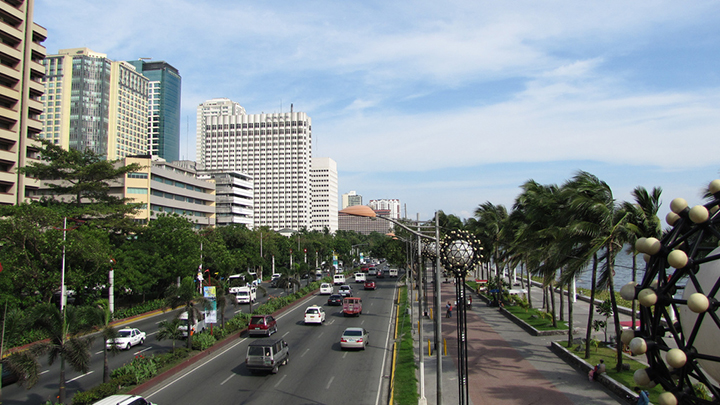
Roxas Boulevard is a popular waterfront promenade in Manila in the Philippines. The boulevard, which runs along the shores of Manila Bay, is well known for its sunsets and stretch of coconut trees. The divided roadway has become a trademark of Philippine tourism, famed for its yacht club, hotels, restaurants, commercial buildings and parks.
Originally called Cavite Boulevard, it was renamed Dewey Boulevard in honor of the American Admiral George Dewey, whose forces defeated the Spanish navy in the Battle of Manila Bay in 1898. The boulevard was again renamed to Heiwa Boulevard in late 1941 during Japanese Home Rule and Roxas Boulevard in the 1960s to honor President Manuel Roxas, the fifth president of the Republic of Philippines.
Roxas Boulevard starts at Rizal Park also known as Luneta Park as a physical continuation of Bonifacio Drive. The road passes through many tall buildings, restaurants, banks, monuments, and other establishments. The United States Embassy is in the Luneta area; a kilometer south the headquarters of Bangko Sentral ng Pilipinas (BSP) and Philippine Navy are located within the Malate district of Manila. After the BSP building, the boulevard enters Pasay, passing through the CCP Complex and Star City.
For us to wander Roxas Boulevard, let’s go for a walk tour, and for this tour we’ll be looking and describing building structures that gives out history and been part of the architectural era of the Philippines.
THE MANILA HOTEL
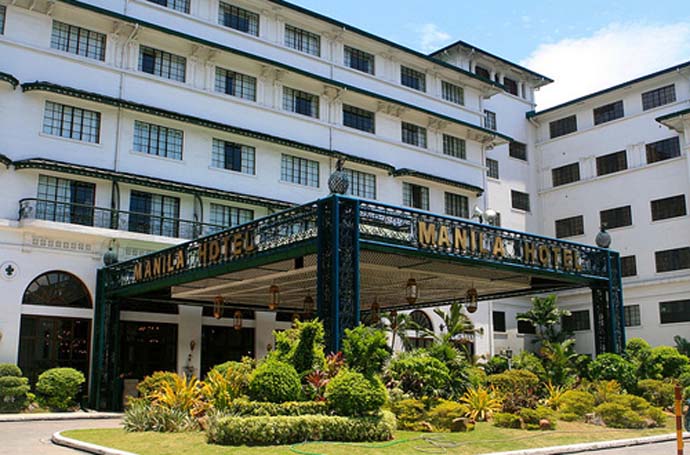
The Manila Hotel is a 570-room, historic five-star hotel located along Manila Bay in Manila, Philippines. The hotel is the oldest premiere hotel in the Philippines built in 1909 to rival Malacañang Palace, the official residence of the President of the Philippines and was opened on the commemoration of American Independence on July 4, 1912. The hotel complex was built on a reclaimed area of 35,000 square metres (380,000 sq ft) at the northwestern end of Rizal Park along Bonifacio Drive in Ermita. Its penthouse served as the residence of General Douglas MacArthur during his tenure as the Military Advisor of the Philippine Commonwealth from 1935 to 1941
Spend some quality time with your loved ones at Manila Hotel. Situated in Rizal Park, Manila, Philippines, this 4-star homey and sophisticated hotel will make you feel the historic moment in our country close proximity to Manila landmarks and the famed Manila Bay sunset. Providing all visitors with complete amenities for work and play, you won’t regret booking a room here. It is a nice venue for a total relaxation, for sure. Indeed, it is one of the perfect spots to cool off even for a while.
Ventilation and protection from rain and sun were essential tenets of Parsons design. Corridors were single-loaded, so that breezes could cross from exterior windows to transoms above doors in the corridors. Broad windows with sliding capiz panels and canopies above created the horizontal banding of the exterior elevations.
As described in Manila Hotel’s guidebook published in 1939, just two years before Pearl Harbor, the Fiesta Pavilion was “one of the finest and most beautiful ballrooms in the world, surrounded by a wide terrace filled with dining tables. It has neither doors nor windows, only a high domed roof supported by giant columns. As you dine, you look out over the fascinating harbor…The Pavilion is open on all sides and the verdant gardens and the blue bay glimpsed thru the coconut palms, form a unique setting
Aristocrat
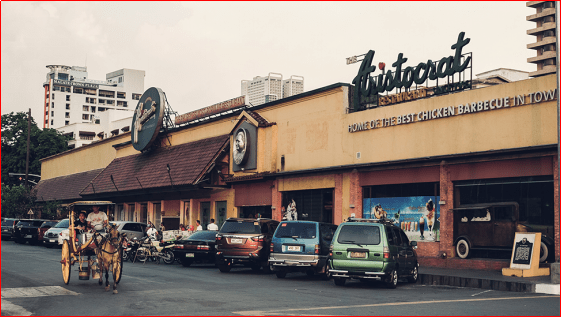
THE ARISTOCRAT is an iconic restaurant that grew from the inspirational rags-to-riches story of Doña Engracia Cruz-Reyes or Aling Asiang. It started as a small vehicle which served as a rolling food stall that roamed around Luneta and other areas in Manila in 1936. By force of circumstance, the rolling store moved from Luneta to Dewey Blvd, now known as Roxas Blvd. And the store that was located in Roxas Boulevard is the first ever physical store of Aristocrat
Aristocrat Restaurant began as a rolling store way back in the 1930s in Luneta. The restaurant has been in business for at least 81 years. It was opened by Engracia “Asiang” Cruz –Reyes, his grandmother, to avoid losing their forks and spoons. Aling Asiang introduced chicken barbeque. In 1928, Since Lola Asiang’s brood was growing, she decided that since she was cooking for a lot of people already (the Reyes family had 13 children) might as well earn from all that effort. Asiang quickly converted the ground floor of their house in Marquez de Comillas into an eatery that she called Lapu-Lapu. Early on she decided that she would always cook and serve delicious and affordable Filipino food.
Since aristocrat is an old style resturant which stated above that it was started in 1928 where filipinoes are still tune up to the spaniard style. The architecture of aristocrat gives ephasis to famous volt of a roman art which aristocrat restaurant adapted. It also an old fashion roof tiles. The color of the restaurant gives an amazing vibrant to the people who wanted to eat. Because yellow means happiness.
US EMBASSY MANILA
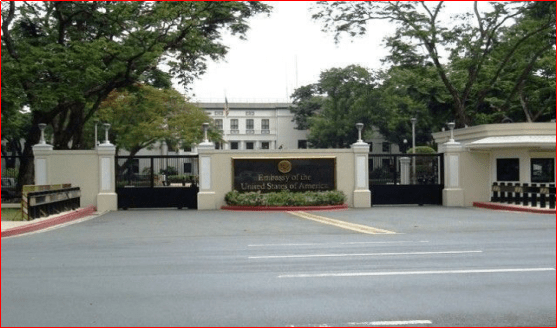
The Embassy of the United States of America to the Philippines is situated in the Chancery Building of the Manila American Embassy along Roxas Boulevard (formerly Dewey Boulevard) in Ermita, Manila. The Embassy has been representing the United States Government since the Philippines was granted independence on July 4, 1946.
The chancery of the Embassy in Manila was first constructed to house the United States High Commission to the Philippines and was designed by the US Treasury Department, Procurement Division, and Public Buildings Branch after considering and later rejecting a design by the notable Filipino architect Juan M. Arellano. The building is built on reclaimed land that was a gift from the Government of the Philippines and sits on more than 600 reinforced concrete piles that were sunk 60 feet into the site. The site was originally designed as a demesne along Manila Bay, which featured a revival-style mansion that took advantage of the seaside vista. It was insisted, though, that a federal-style building be built. American Federal architecture typically uses plain surfaces with attenuated detail, usually isolated in panels, tablets, and friezes. It also had a flatter, smoother facade and rarely used pilasters. It was most influenced by the interpretation of ancient Roman architecture, fashionable after the unearthing of Pompeii and Herculaneum. The bald eagle was a common symbol used in this style, with the ellipse a frequent architectural motif. The Chancery was completed in 1940.
During World War II, after the Fall of Bataan, the property became the residence of the Commander-in-Chief of the Imperial Japanese Army in the Philippines. When the Japanese- sponsored Puppet Republic was established in 1943, the building was repainted and refurbished and served as the Embassy of Japan to the Philippines. During its recapture by Allied forces and Philippine guerrillas, the building was seriously damaged but its ballroom, among other rooms, remained intact.
In October 1945, Quonset huts were erected throughout the property and became known as The Courthouse, the center of the Japanese war crimes trial in the Philippines, with the ballroom serving as the courtroom and the upstairs rooms serving as holding cells. On July 4, 1946, the Philippines were granted independence by the United States and the building became known as the United States Embassy in Manila.
As a testament to its battle-scarred history, its flagpole was never restored and still retains the bullet holes it sustained during the war. The chancery has also been designated as historic property by the National Historical Institute of the Philippines as well as being on the United States Secretary of States register of culturally significant places.
BANGKO SENTRAL NG PILIPINAS (BSP) – Manila
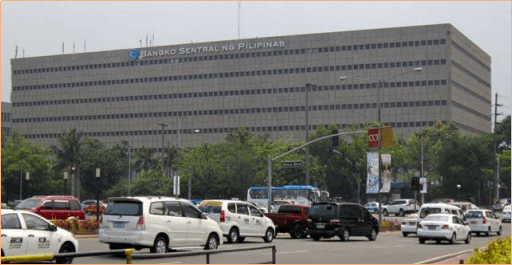
The BSP Main Complex in Manila houses the offices of the Governor, the Monetary Board and the different operating departments/ offices. The Complex has several buildings, namely: 5-Storey building, Multi-storey building, the EDPC building and the BSP Money Museum, which showcases the Bank’s collection of currencies and can be seen along Roxas Boulevard.
The Bangko Sentral ng Pilipinas is the central bank of the Philippines. It was established on July 3, 1993, pursuant to the provision of Republic Act 7653 or the New Central Bank Act of 1993.
It is one of the Postwar styles of Philippine architecture classified as “Post-Independence/Post-Colonial, specifically, Brutalism.It is a harmonious composition of massive concrete blocks relieved of their severity by continuous horizontal bands of windows. And the Architect of this building is Gabriel Formoso an architect who emphasized three points on his philosophy of design: first, architecture is a fine art committed to creating beauty; second, the social nature of architecture places a unique responsibility on the architect, that a building becomes part of the environment and functions in a dynamic interaction with it; and third, architecture must strive for simplicity. While some of Formoso’s buildings are characterized by cool elegance, others are notable for their warmth and ruggedness.
Philippine Navy
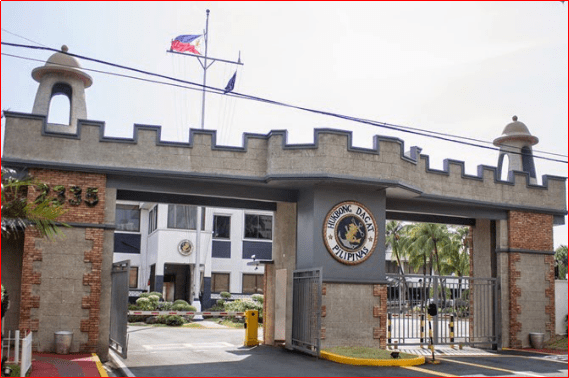
The Philippine Navy (Hukbong Dagat ng Pilipinas) is the naval warfare service branch of the Armed Forces of the Philippines. It has an estimated strength of 24,000 active service personnel, including the 7,500-strong Philippine Marine Corps. It shares the responsibility of patrolling the maritime borders with the Philippine Coast Guard, a formerly attached unit which became a separate maritime law enforcement agency in 1998. Located and situated along Roxas Boulevard
On Sunday, June 25, 1950, the existence of the Republic of Korea as a democratic nation was shattered when armored and infantry elements of the North Korean People’s Army crossed the border into Seoul. The surprise attack caught off guard the Republic of Korea Armed Forces who lacked the equipment to withstand a massive communist invasion.
On that same day, the United Nations Security Council Resolution Number 82 was enacted which called for the immediate withdrawal of the belligerent forces from South Korea. It went unheeded prompting the world body to pass UNSC Resolution number 83 calling on member countries to support militarily the ROK in deterring communist aggression.
Concerns about the Chinese incursion to the sea features claimed by the Philippines and other Southeast Asian states were more pronounced in the last years of the 20th century. This was more evident after the Chinese construction of a military outpost at the Mischief Reef on 1995. As a response, the Philippine Navy dispatched the BRP Sierra Madre and deliberately ran it aground in the Second Thomas Shoal, 5 miles from the Chinese facility and south of the rumored oil-rich Reed Bank, which it maintains as its own station today. However, it remains unable to protect other Philippine Reefs that have been reclaimed by the Chinese
Cultural Center of the Philippines Complex
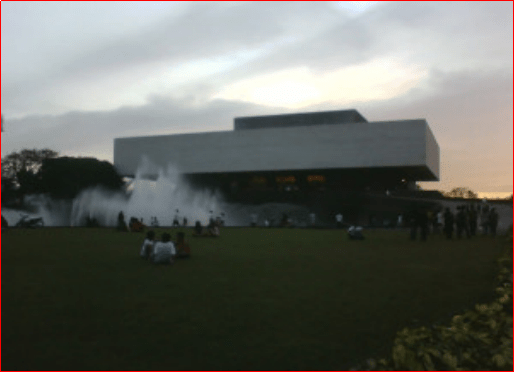
The Cultural Center of the Philippines Complex, also known as CCP Complex, is an 88-hectare (220-acre) owned by The Cultural Center of the Philippines (CCP) located along Roxas Boulevard in Metro Manila, Philippines, most of which fall under the jurisdiction of the city of Pasay.
The Cultural Center of the Philippines is an essence of original Filipino design inspired by the various styles but most generally International Style during that period when this structure was built. The most prominent characteristics of International Style buildings are rectilinear forms; light, rigid plane surfaces that have been completely exposed; open interior spaces by the use of glasses in genera; and an illustrational weightless quality produced by the use of cantilever construction.
This great structure was led by previous President Ferdinand Marcos in 1969 merely to “promote and preserve Filipino arts and culture, and to become a Mecca or center of culture and the arts in Asia.” In addition, I noticed that the rest of the structure is clad in concrete, textured by crushed seashells, the parts or the shell itself within the concrete that was used mainly in street and amazingly in structure itself. In the entrance to ccp its wide cantilever was all designed by massive structures or construction and more of geometrical shapes incorporated to itself. Also the walls outside was entirely made of marble and was cladded by seashells. And I also notice those small openings beneath its corrugated textured walls.
Folk Arts Theater
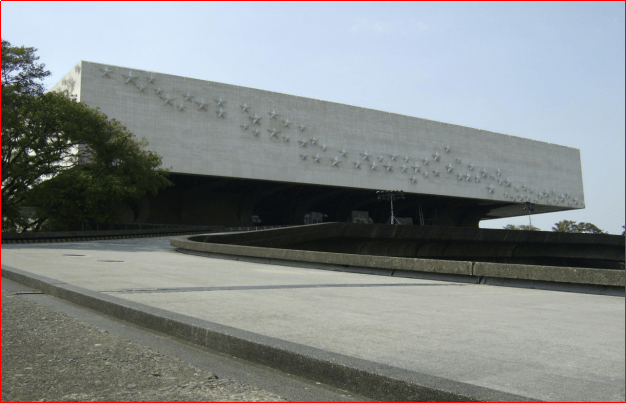
Folk Arts Theater is also known as The Tanghalang Francisco Balagtas. It is one of the performance venues of the Cultural Center of the Philippines.
This covered proscenium amphitheater is where entertainment such as popular concerts, musicals, and plays are usually staged. It has 8,458 seating capacity in ten sections. The theater takes its name from Francisco Baltazar also known as Francisco Balagtas, in awe to the country’s greatest poet. The theater was built in 90 days and was designed by Leandro V. Locsin in 1974.
The building was officially authorized by First Lady Imelda Marcos for the Miss Universe Beauty Pageant in 1974, which was to be held in Manila in the same year.
MANILA FILM CENTER ( AMAZING SHOW )
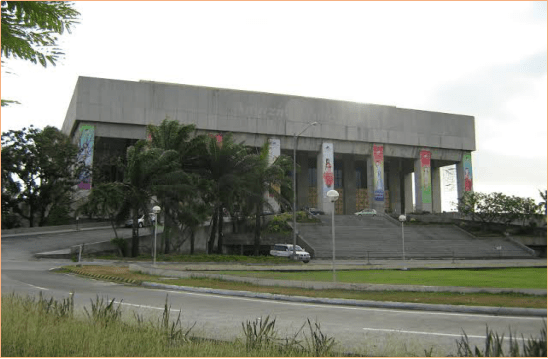
The Manila Film Center is a national building located at the southwest end of the Cultural Center of the Philippines Complex in Pasay, Philippines. The structure was designed by architect Froilan Hong where its edifice is supported on more than nine hundred piles which reaches to the bed-rock about 120 feet below.
The Architectural style of this building is Brutalism the construction of this building started 1981 and was completed 1982. Brutalism because the building has been the subject of controversies due to a fatal accident that happened on November 17, 1981.
Prior to the Manila Film Center, the Philippines did not have an official national film archive which is why on January 1981, then first lady Imelda Marcos spearheaded the building of the first Manila Center. Under the supervision of Betty Benitez, the spouse of then Deputy MHS Minister Jose Conrado Benitez, they organized a group to pursue the project
Several ocular visits were done by Unesco in 1981 where they were responsible for major consultations needed in the structure’s erection. The building was then designed to have two components which were the auditoria and archives. According to Hong, the foundation was set on reclaimed land near the Manila Bay. Since the deadline of the structure was tight, it required 4,000 workers, working in 3 shifts across 24 hours. One thousand workers constructed the lobby in 72 hours, a job which would normally entail six weeks of labor. The Film Center opened in 1982 costing an estimate of $25 million.
An accident occurred around 3:00 a.m. on November 17, 1981 during the construction of the Manila Film Center. The scaffolding collapsed,and at least 169 workers fell and were buried under quick-drying wet cement. A blanket of security was immediately imposed by the Marcos regime. Neither rescuers nor ambulances were permitte on the site until an official statement had been prepared. The rescuers were eventually permitted to go inside the accident site nine hours after the collapse.
Amidst everything, the first Manila International film festival pushed through from the 18th to the 29th of January 1982. A total of 17 movies competed in the festival.
Star City
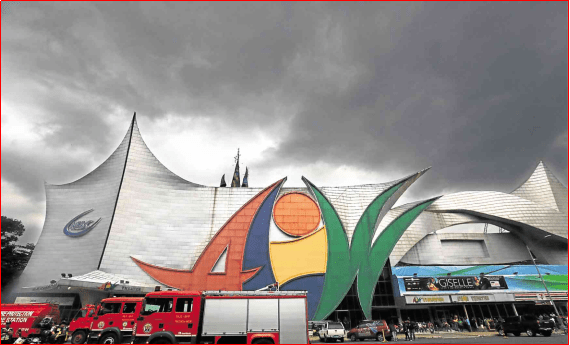
Star City was established in 1991 as an offshoot of the annual Toys and Gift Fair, a Christmas trade exhibition by the Philippine Center for International Trade and Exhibit (PhilCite) which first organized in 1976. Under Fred Elizalde, the fair evolved into an amusement park later named Star City. The former PhilCite building upon which the park was based upon was pulled down in the late 1990s to make way for the park’s indoor rides.
Star City offers a wide variety of rides for the whole family. For kids, they have the Little Tykes, Quack Quack, Rodeo, Ball Pool, Tea Cup, Kiddie Pool, Kiddie Bump Car, Frosty Train, Mini Pirate Ship, and Road Race.
Aside from kiddie rides, the park also offers family rides like Egyptian Spinning Coaster, Giant Star Wheel, Grand Carousel, Telecombat, Wacky Worm, Red Baron, Magic Forest, Dragon Express, Annex Carousel, and Happy Swing.For those hanging out with friends, you can try their group-friendly rides including Tornado, Music Express, Bump Car Smash, Bump Car Rave, Bumper Boat, and Jumping Star. Don’t forget to explore other thrilling rides like Star Frisbee, Viking, Star Flyer, Jung Splash, and Surf Dance for a heart-stirring experience.
Through the years, Star City never loses its magic to kids and kids at heart. It continues to reinvent and upgrade its facility to attract people of all ages. From the simplest to the more extreme rides, they have it all here. But sadly, recently the Star city was caught on fire and since then it was been closed and not open to give magic to people.
Philippine International Convention Center
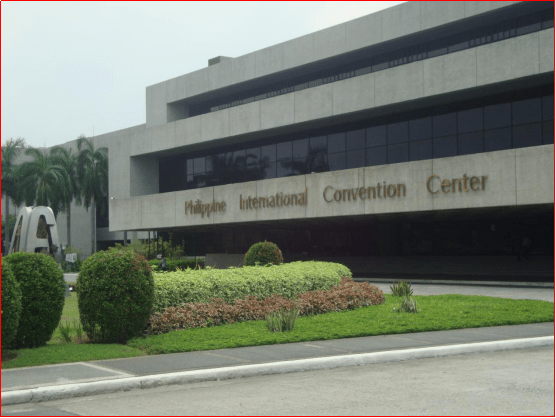
The Philippine International Convention Center or “Sentrong Pangkumbensyong Pandaigdig ng Pilipinas” (PICC) is a convention center located in the Cultural Center of the Philippines Complex in Pasay, Metro Manila. This has been the host of numerous local and foreign conventions, meetings, fairs and social events.
Built in a span of 23 months, from November 1974 to September 1976, with its architect, Leandro Locsin, the PICC made history as Asia’s first conventional center. It has The Philippine International Convention Center is composed of five building modules; the Delegation Building, Secretariat Building, Plenary Hall, Reception Hall and The Forum. It was built in reclaimed land and has a floor area of more than 65,000 sq ft (6,000 m2).
In my perspective, it is a very common building in the Philippines. It is not that unique from most architectural design. But you can see and appreciate its history, purpose and influence as it stands proudly in the most crowded and populated area in the country.
SOFITEL PHILIPPINE PLAZA MANILA
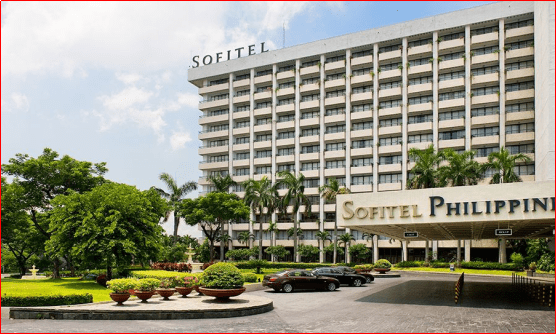
The creation of the Sofitel Philippine Plaza Manila was linked with the founding of the Cultural Center of the Philippines in 1969. In 1966, first lady Imelda Marcos took Malacanang Palace guest of honor John D. Rockefeller Jr. for a drive along Roxas Boulevard.
Pointing out where the cultural center was going to be built, the American philanthropist protested, “But Mrs. Marcos, its water.” The first lady replied, ‘on the first year, I’ll cover the soil. On the second year, I’ll drive the pile. On the third year, the building will rise. On the fourth year, the curtain will rise”. Built to host the prestigious IMF- World Bank Annual Meeting, the Sofitel Philippine Plaza Manila (formerly called Philippine Plaza Hotel) was inaugurated on September 26, 1976. It was a $500 million project that at the time was the most expensive hotel ever built anywhere in the world.
The vernacular renaissance in Philippine architecture reached unprecedented heights in the 1970’sand Sofitel Philippine Plaza Manila, a Leonardo Locsin signature work of art, is an extravagant celebration of Filipino identity and brilliance in contemporary design and artistry. A celebrated icon, Leandro Locsin is the architectural genius behind unique Filipino masterpiece including the cultural center of the Philippines, Bulwagang Francisco Balagtas (now Folks Arts Theatre). The Philippine International Convention Center and the Ninoy Aquino International Airport. He is the creative visionary behind the Sofitel Philippine Plaza Manila, the first, biggest and most expensive city resort hotel in Asia during its rise.
A step into the opulent hotel imprints a quaint allure that entwines two unique cultures and metropolitan narratives. The earth colors, illuminated pearl inlays and textures of dark wood in modern lines provide a distinct ambiance- Filipino contemporary design and classic European old world charm tastefully intertwined. The Parisian topiaries and elaborate floral arrangements, signature brand aroma, pipe in music and classic French rituals blend impressively with the sophisticated style and splendor of the art décor adding glamour and French elegance to distinct Filipino masterpiece.
THE AUTHORS






REFERENCES:
- www.bsp.gov.ph
- https://en.m.wikipedia.org/wiki/Roxas_Boulevard
- “Manila National Film Centre, Page 2, Annex 1, Building Specification”(PDF). Unesco. Retrieved 2009-01-16.
- “MIFF Press Release”. Open Library, Published in 1982, Office of Media Affairs (Manila). Retrieved 2009-01-16
- pinterest.com/GabrielFormoso
- wikipedia.com
- https://www.aristocrat.com.ph › our-history
- https://www.manila-hotel.com.ph › our-history
- https://www.culturalcenter.gov.ph
- https://en.wikipedia.org › wiki › Star_City_(amusement_park)
- philippinenavy.tripod.com › history
 ARTCCOUNTANTS